

Transcript of my Spencer Pratt monologue
Substackers got a special edition of the interview with a 10-minute intro. Now you can read it, too.

The Substack version of the Spencer Pratt episode (the one you got if you subscribe here) included a 10-minute introduction in which I provided more context on the L.A. mayoral race and my thoughts on Pratt’s candidacy. I think it’s really important that people hear it and I thought I’d post the transcript here, in case you want to read as well as listen.
I recorded this last week, when incumbent mayor Karen Bass was polling in the lead. Things have been shifting since then, depending on what polling you follow — or believe. (Please don’t follow the Polymarket posts!)
In the nearly six years I’ve been doing this podcast, I’ve never interviewed a political candidate. I’ve never really focused on local issues, since my audience is all over the place — and hearing about local politics in cities you don’t live in is kind of like hearing people describe their dreams. But this election is different. I’m going to spend a few minutes talking to you, my Substack audience, about why I think that is.
If you were to ask me what the city of Los Angeles feels like these days, I might say it’s like a critically ill patient lying on a gurney in an emergency room for hours — maybe days — waiting for medical attention. Maybe an orderly comes by, maybe a nurse’s assistant, maybe there’s a tangle of IVs hanging from a pole that someone has rigged up as a stopgap until an assessment can be made. There are a lot of excuses about procedure and backlog, and how this is just the way it is in a big city hospital. But there’s no doctor, no coordination, no acknowledgment that this patient is very, very sick and needs to be seen now.
That’s what the relationship between Los Angeles residents and our elected officials feels like.
Now, Spencer Pratt — if you’re not familiar with him, and I wasn’t — starred on a reality show called The Hills. It ran for six seasons starting about twenty years ago. He played himself, along with his girlfriend-turned-wife, Heidi Montag. The show was heavily scripted by producers, and the two of them were crafted essentially as the villains. After the show, and after blowing a fortune on Birkin bags and a six-figure crystal collection — he spells all of this out in his book, by the way — Spencer launched a surprisingly lucrative online business selling crystals and settled into a relatively quiet family life in Pacific Palisades, where he’d grown up.
He had a political science degree from USC, but zero political ambitions until last year, when his house burned down in the wildfire and his frustrations with the recovery process — and the political negligence that had contributed to the fire in the first place — sent him down the rabbit hole of LA city politics. On January 8th of this year, one day after the first anniversary of the fire, he announced he was running for mayor.
The leading candidate is incumbent Karen Bass, and I’ll say a few things about her so you understand why he talks about her the way he does — fairly or unfairly. Bass is a career politician with a background in progressive activism. Her detractors like to call her a communist, partly because back in the 1970s she traveled to Cuba repeatedly and expressed solidarity with the revolution there, which is something you did if you were a young Black progressive activist at the time, which she was. When Castro died in 2016, Bass called it a great loss for the people of Cuba. She walked that remark back in 2020. Do with that what you will.
On February 7th of this year, hours before the filing deadline, another candidate entered the race: democratic socialist Nithya Raman, who sits on the city council, chairs the Housing and Homelessness Committee, and represents areas stretching from the San Fernando Valley to Hollywood and beyond — areas that have some of the worst homeless encampments in the city outside of Skid Row.
That was a lot of detail, but I’m including it because these names come up in the conversation. Honestly, a lot of people in LA don’t even know who’s running in these local elections, let alone people in the rest of the country. There are several other candidates in this primary, but these are the top three contenders.
So back to Spencer Pratt. Like a lot of people, I at first thought he was a joke. I thought: we elected a reality star president and look how that turned out. But then, through the urging of a few friends, I started paying attention. I especially paid attention to the way Pratt was talking about the apocalyptic state of street homelessness in this city — an issue I’ve become rather obsessed with over the past year, and not least because of something that almost nobody talks about, because frankly it’s so upsetting: the horrific abuse of animals, mostly dogs, at the hands of drug addicts, drug dealers, and various other people on the street who have no business being in possession of a helpless animal.
Spencer Pratt is talking about that. He’s talking about the utterly inhumane and depraved conditions on many of our streets in a way that no public official has been willing to do. He’s talking about the labyrinth of NGOs and nonprofits that have contributed to this situation.
He sometimes speaks hyperbolically. His word for fentanyl- and meth-addicted people on the street who refuse treatment is “zombies.” It’s not the word I would choose if I were running for office — but if you live in a city like this, you know exactly what he means. At one point in the interview, Pratt mentions body brokers. These are paid recruiters who funnel homeless and addicted people into treatment facilities as a vehicle for Medicaid billing fraud. The patients are literally the product. If you don’t believe me, look it up. It’s a real thing. It’s not a conspiracy theory.
If I had my journalist hat on, I would not be running an interview with a political candidate I’m also actively supporting. That would be unethical. But this is not a news podcast. It’s my show.
If you live in Los Angeles and vote in the mayor’s race, I hope you’ll hear him out. But even if you don’t live here, I want you to hear what’s going on in this city — and in so many cities like it. Because here’s the thing: even if Spencer Pratt loses this election, or even if he wins and can’t get nearly as much accomplished as he’d like to think he can, I believe he will have done a monumentally important thing, which is to describe out loud what everyone can see with their own eyes and yet is consistently denied or diminished by our public officials. I think that would be profoundly unifying. A little surreal, yes — but also an experiment in being citizens together in a new way.
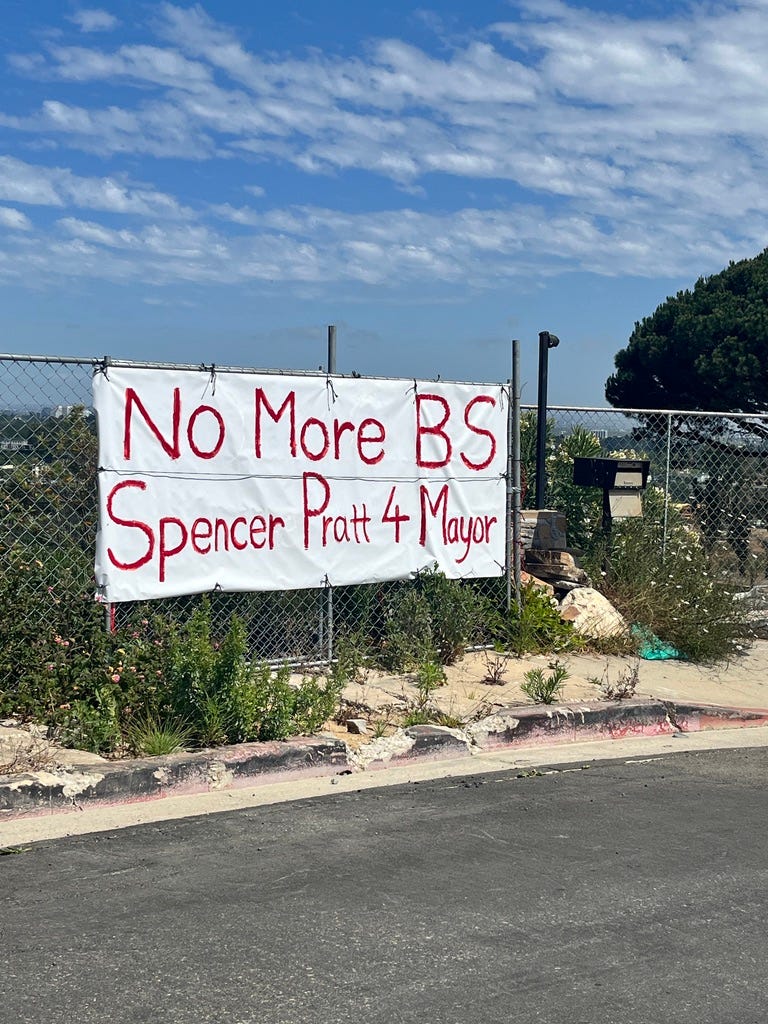
As I was driving up to Spencer’s lot in the Palisades, I passed a homemade sign attached to a fence along the road of scorched properties. It said: “No More BS. Spencer Pratt for Mayor.” And I think that says it all. This is not about Democrat versus Republican, left versus right. It’s about stopping the bullshit. I think that’s what most people want. We’re ready for a no-bullshit era. And to think that this era might be ushered in by a guy that everyone loved to hate on an MTV reality show — well, that’s kind of the perfect Hollywood story.
Related epsidoes
Meghan - need to hear your thoughts on the debate (also want to read some fact checking on the claims made and also opinion on what Pratt can do to strengthen his argument). Prediction markets say he doesnt have a chance ... but I'm now curious as to what will change minds regarding homelessness. Big critique I see is that homelessness is due to lack of affordable housing and not drugs/ untreated severe mental health conditions - dont demonize the unhoused. I suppose I didn't realize people were still so stuck on this.
Also the debate on what harm reduction really is. Seems ideas about harm reduction need to be updated post AIDS epidemic. Why are people so willing to participate in another person's death by enabling drug use?
I am of the view that being a "career politician" is not necessarily a bad thing. I read career writers. I want a career doctor. So on it's own, without judging any individual, it is generally an asset but I believe I am in a major minority.